Standardized classifications in the report: a guide to BI-RADS, TI-RADS and O-RADS
BI-RADS, TI-RADS and O-RADS are three different systems built on the same reasoning: a closed lexicon, a composition rule and a management recommendation per category. See what they share, where they differ and the error each one was created to eliminate.
 LaudárioUltrasound reports in practice
A pattern repeats throughout modern radiology: take an organ where the clinical decision is difficult, create a closed lexicon of descriptors, and turn the combination of those descriptors into a risk category with associated management. The American College of Radiology did this for the breast (BI-RADS), the thyroid (TI-RADS) and the adnexa (O-RADS). They are three different systems, but the reasoning behind all three is exactly the same, and understanding that shared reasoning is what lets you use any of them without consulting the table at every exam.
This guide is an overview of the three: what they have in common, where they differ, and the specific error each one was created to eliminate. Each system has a dedicated, in-depth article, linked throughout the text.
The shared logic: the descriptor decides, not the impression
Before the RADS systems, the report of a lesion was an opinion: "nodule with a benign appearance", "complex cyst", "probably innocent finding". The problem is not that these phrases are wrong, but that they are not auditable. No one can verify how the examiner arrived at them, no one can reproduce the conclusion, and the physician who receives the report has no way of knowing how much to trust it.
The three systems solve this with the same engineering, in three layers:
- A closed lexicon. You do not describe the lesion with whatever words you like. You answer a fixed set of questions (shape, margin, echogenicity, content, vascularity), and each question has a fixed set of possible answers.
- A composition rule. The combination of descriptors determines the category. The examiner does not choose the category; the combination produces it. In TI-RADS this is literal: the descriptors become points and the sum becomes the category.
- A management recommendation per category. The category is not an adjective; it points to an action: nothing, follow-up, biopsy, referral.
The practical consequence of this architecture is that the report stops transferring the decision. "Complex cyst" pushes the problem onto someone who did not see the image. "O-RADS 4" says what to do.
The three systems at a glance
What changes between them is the organ, the risk axis and the intervention trigger:
| System | Organ | Categories | What triggers management |
|---|---|---|---|
| BI-RADS | Breast | 0 to 6 | The category itself: 4 and 5 call for biopsy |
| TI-RADS | Thyroid | TR1 to TR5 | Category crossed with the size of the nodule |
| O-RADS | Ovary and adnexa | 0 to 5 | The category itself: 4 and 5 call for MRI or a specialist |
Note the difference in TI-RADS, which is the source of half the errors of those who migrate from one system to another: in it, the category alone does not indicate biopsy. An 8 mm TR5 is not biopsied; a 3 cm TR3 is. Size is not a detail of the report, it is half of the decision. In the other two, size plays a smaller role (in O-RADS it appears as the 10 cm cutoff; in BI-RADS it hardly weighs in).
BI-RADS: the grandfather of them all
BI-RADS is the oldest and most established, and therefore has the most mature culture, including auditing: a service can and should measure its own predictive value per category. It is also the only one of the three with a category for a lesion with an already confirmed diagnosis (6).
The points that most change reports in practice:
- Category 3 is a promise, not a doubt. It means "I am so confident this is benign that I accept following it instead of biopsying it", with a risk of malignancy below 2%. Using it as a drawer for whatever you do not know how to classify is the most common abuse of the system, and destroys the value of the category.
- The subdivision of 4 (4A, 4B, 4C) exists because the risk range is too wide for a single decision, and post-biopsy management depends on it: a benign result in 4A is concordant and closes the case; the same result in 4C is discordant and requires rebiopsy.
- Category 0 is incomplete, not indeterminate, and this distinction confuses many people.
The full article, with the descriptors of shape, orientation, margin, sonographic pattern and associated findings, along with management by category, is at BI-RADS in breast ultrasound: how to describe lesions and standardize the report.
TI-RADS: where the report becomes arithmetic
ACR TI-RADS is the most mechanical of the three, and this is a virtue: it scores five morphologic categories (composition, echogenicity, shape, margin and echogenic foci), adds up the points, and the sum defines TR1 to TR5. There is no room for impression.
What tends to slip through:
- Points accumulate within echogenic foci. Unlike the other categories, there you mark everything that applies and add it up; you do not choose one.
- Do not confuse "more suspicious" with "biopsy". The management table crosses category and size, and that is what decides. Reporting TR4 without the measurement makes the report useless for the decision.
- Posterior acoustic shadowing and macrocalcification are not the same thing, and they score differently.
- Spongiform nodules have their own shortcut: they are benign by default, regardless of the rest.
If you already report thyroid, the detailed article with the scoring of each category and the size-based management table is at Thyroid ultrasound and TI-RADS: how to describe and classify nodules in the report. It is worth reading alongside the one on neck ultrasound, because a suspicious lymph node changes management much more than the nodule itself: a TR3 with a metastatic lymph node is not a follow-up case.
O-RADS: the newest, and the one with the most to correct
O-RADS is the most recent of the three and confronts the most entrenched habit: the "complex cyst". It is probably the most dangerous term in the gynecologic report, because it has no associated risk, no management and does not allow auditing. The O-RADS lexicon was designed precisely so that this escape route cannot exist: when you are required to answer type, solid component, locularity, margin, papillary projections and color score, "complex" is simply not a possible answer.
Two shortcuts of the system that greatly simplify practice:
- In a solid lesion, an irregular margin goes straight to O-RADS 5; the color score does not rescue it.
- Ascites and peritoneal implants are O-RADS 5 by themselves, regardless of how the mass is characterized.
And a reminder that avoids unnecessary referral: a corpus luteum and a follicle are not lesions. They are O-RADS 1, physiologic, and the ring of fire of the corpus luteum is the signature that settles the doubt at no cost. In postmenopause, however, they do not exist, and the same image needs to be reclassified.
The full article, with the five categories, the lexicon, the color score and the typical lesions, is at O-RADS on ultrasound: how to classify adnexal masses and stop reporting "complex cyst". Since O-RADS lives inside the pelvic exam, it is worth reading alongside the one on transvaginal pelvic ultrasound, and, when the finding is an endometrioma, the one on deep endometriosis mapping, because finding an endometrioma is the beginning of the search, not the end.
The errors all three share
After seeing many reports with a RADS category, the same problems appear regardless of the organ:
- A category without the descriptors that support it. A report that says "O-RADS 4" or "TR4" without describing why allows neither a second opinion nor an audit. The category is the conclusion of a line of reasoning; the reasoning belongs in the document.
- Omitting the measurement. In TI-RADS it is half of the management. In O-RADS it moves the category at the 10 cm cutoff. Without a measurement, it is better not to classify than to guess.
- Using the intermediate category as a drawer. BI-RADS 3 and O-RADS 3 do not mean "I don't know"; they mean "I know enough to follow instead of intervening".
- Classifying the physiologic. Corpus luteum, follicle and cyclic changes are not lesions.
- Reporting vascularity as an adjective. "Vascularized" is not a criterion; the color score of 1 to 4 is.
- Not classifying each lesion. When there are several, each has its own category, and management follows the highest one, without forgetting the others.
Where to start if you do not use any yet
The practical recommendation is to start with the organ you report most often, and to use the complete system from the first exam, including normal ones. Half of the benefit of the RADS systems comes from the discipline of always going through the same descriptors: that is what prevents an important finding from slipping by because the exam was rushed that day.
And it is worth understanding that the three are not "just more bureaucracy". They are the difference between a report that confirms the obvious and one that decides management. If this is the kind of change that interests you, the text on standardizing ultrasound reports discusses how to implement this in your routine without losing speed.
What orbits the three systems
Two topics are not RADS systems, but they live inside them and deserve a place in this guide.
Elastography is the fine adjustment: it does not replace the morphologic lexicon, but it moves a category at the margin. Stiffness raises a nodule from 3 to 4, softness downgrades a marginal 4 to 3, and nothing rescues a 5. It is worth knowing the two techniques, the Itoh score and the reason why kPa and m/s cannot be converted by simple proportion, in Nodular elastography: breast, thyroid and prostate.
And, in BI-RADS, the axilla is half the story and tends to become a footer sentence. The lymph node has its own lexicon, its own category (atypical is 4; typical or reactive is 2) and one number that decides everything: the cortical thickness. It is covered in Axillae and lymph nodes: the axillary staging report.
How Laudário helps
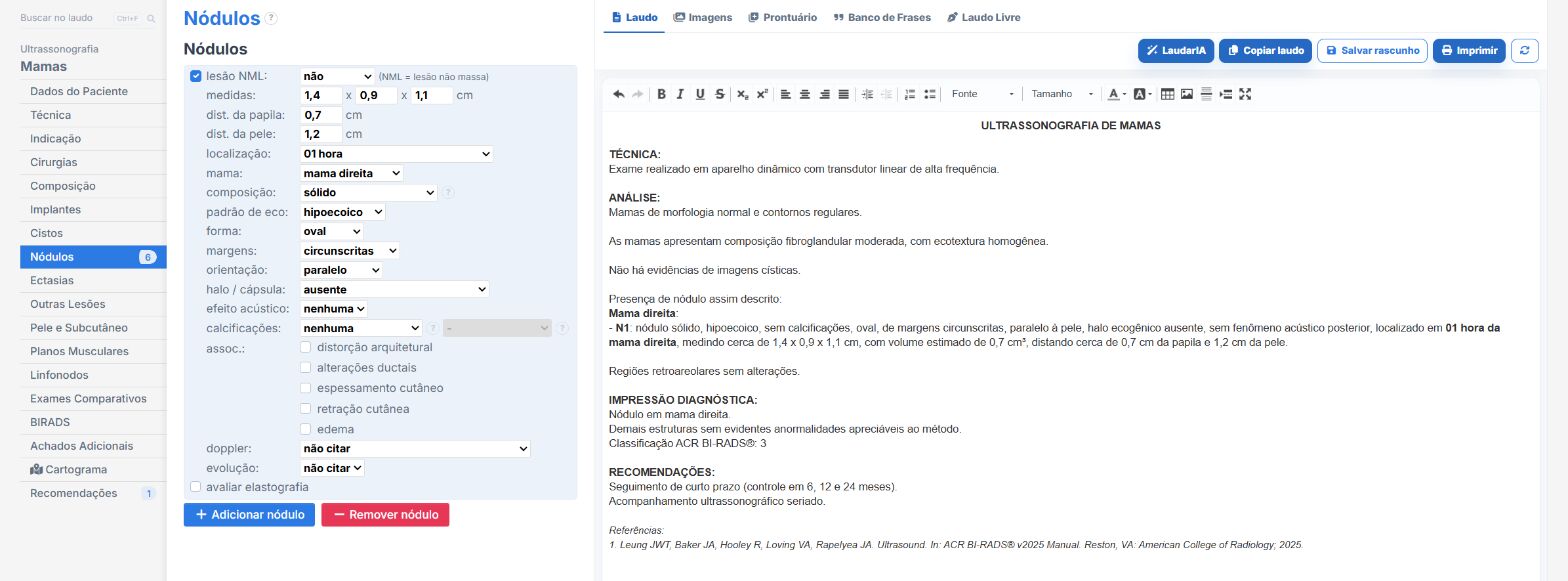
Laudário brings all three systems integrated into the breast, thyroid and pelvic modules, with the category derived automatically from the descriptors rather than chosen by hand. In practice:
- Complete lexicon in dedicated fields, with no room for "complex" or "benign appearance".
- Category calculated from the combination of descriptors, including the shortcuts (irregular margin, spongiform, ascites) and the size cutoffs.
- In TI-RADS, the points are summed and crossed with the measurement to indicate FNA, follow-up or nothing.
- Fields that only appear when they are decisive: fewer clicks, less noise, fewer errors.
- Management recommendation by category written into the report, adjusted to the context (such as menopausal status in O-RADS).
- Support from LaudarIA for difficult cases: multiple lesions, bilateral findings, patients in follow-up.
If you want to standardize your classifications without typing more, it is worth trying: 15-day free trial, no credit card required, with all templates unlocked.
The ultrasound reporting platform built by sonologists. We write about reports, classifications and standardization from the real routine of the practice. Who writes and how.
Educational content for healthcare professionals. It does not replace clinical judgment or the guidelines adopted by your service. Editorial policy.