Fetal Urinary Tract Dilation: The UTD Classification and What to Measure Prenatally
How to measure the anteroposterior diameter of the renal pelvis, the cutoffs by gestational age, the difference between UTD A1 and A2-3 and the findings that change risk, such as peripheral calyces, ureter, bladder and amniotic fluid.
 LaudárioUltrasound reports in practice
This article is part of the guide Obstetric ultrasound: the three-trimester guide, from dating to Doppler.
Renal pelvis dilation is one of the most frequent findings on the anatomy scan, and it is almost always transient. But terms such as "pyelectasis", mild "hydronephrosis" and "pelvic ectasia" were used for years with different cutoffs, which made it hard to know who needed follow-up. The UTD (urinary tract dilation) classification, published in 2014 by a consensus of societies of radiology, urology, pediatric nephrology and fetal medicine, unified the language.
How to measure
The anteroposterior diameter of the renal pelvis (APD) is measured in a transverse plane of the kidney, at the intrarenal portion of the pelvis, with the fetal spine preferably in an anterior or posterior position. The extrarenal portion of the pelvis is not measured.
The cutoffs
The APD is considered normal when:
- Between 16 and 27 weeks: less than 4 mm.
- From 28 weeks: less than 7 mm.
Besides the APD, the classification considers calyceal dilation (central or peripheral), parenchymal thickness and appearance, the ureter, the bladder and the amniotic fluid.
UTD A1: low risk
- APD from 4 to less than 7 mm between 16 and 27 weeks, or from 7 to less than 10 mm from 28 weeks.
- With or without central calyceal dilation.
- Without the risk findings below.
Recommendation: a repeat ultrasound from 32 weeks and postnatal evaluation.
UTD A2-3: increased risk
- APD of 7 mm or more between 16 and 27 weeks, or 10 mm or more from 28 weeks, or
- Any one of these: peripheral calyceal dilation, abnormal parenchyma (thinned or hyperechoic, cortical cysts), dilated ureter, abnormal bladder (thickened wall, ureterocele, dilated posterior urethra) or oligohydramnios without another cause.
Recommendation: reassessment in 4 to 6 weeks, according to the case, and specialized follow-up after birth. With an abnormal bladder and oligohydramnios in a male fetus, the hypothesis of posterior urethral valves should appear in the report.
What the report needs to include
- APD of each kidney, in mm, with the plane used.
- Calyces: no dilation, central or peripheral dilation.
- Parenchyma: thickness and echogenicity.
- Ureters and bladder.
- Amniotic fluid.
- UTD classification (A1 or A2-3), for the right and left sides.
Common errors
- Measuring the extrarenal pelvis or in a longitudinal plane.
- Using "pyelectasis" or "mild hydronephrosis" without the classification.
- Ignoring the calyces, ureter and bladder and classifying by APD alone.
- Using the same cutoff before and after 28 weeks.
- Not recommending postnatal evaluation in UTD A1.
See also our obstetric ultrasound guide.
How Laudário helps
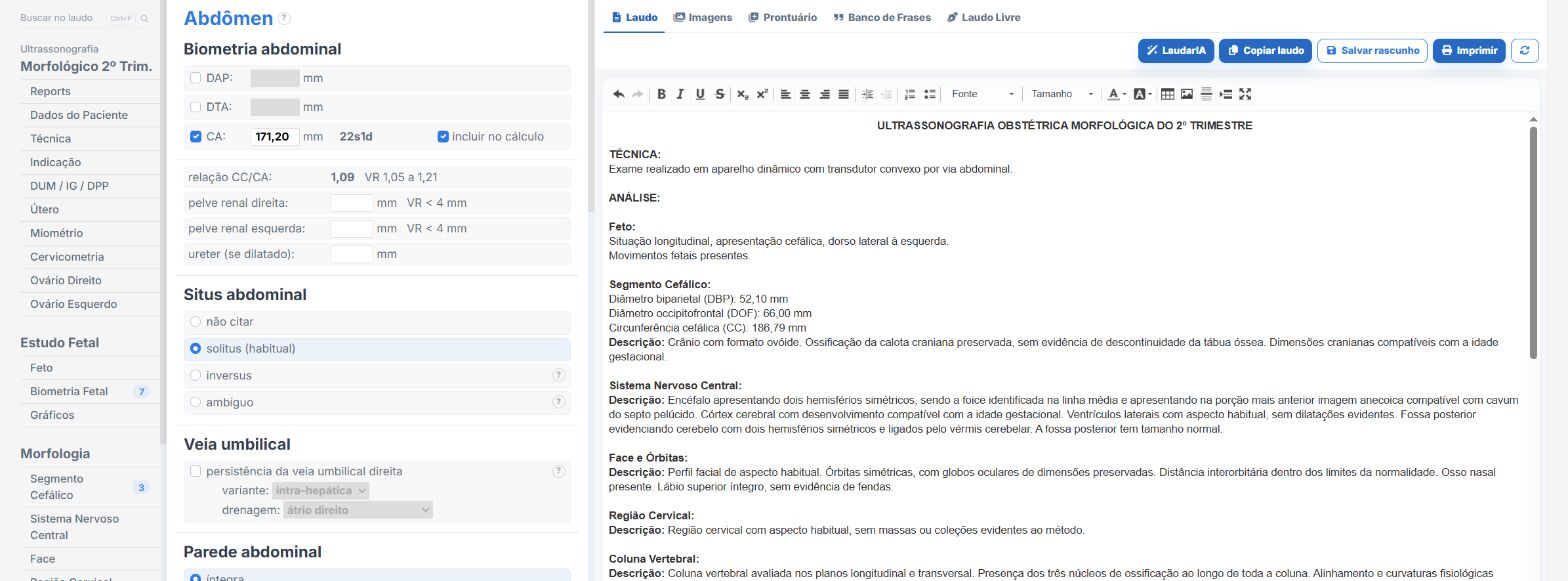
In the obstetrics and anatomy scan templates of Laudário:
- Fetal kidneys and urinary tract in their own fields, with laterality.
- The conclusion is assembled from the checked findings.
- Recommendations in their own tab, separate from the findings.
Try it for 15 days free, no credit card.
The ultrasound reporting platform built by sonologists. We write about reports, classifications and standardization from the real routine of the practice. Who writes and how.
Educational content for healthcare professionals. It does not replace clinical judgment or the guidelines adopted by your service. Editorial policy.