Fetal growth restriction: the Delphi consensus criteria and what to write in the report
The difference between a small-for-gestational-age fetus and growth restriction, the Delphi consensus criteria for the early and late forms, and how Doppler enters the diagnosis and the report.
 LaudárioUltrasound reports in practice
This article is part of the guide Obstetric ultrasound: the three-trimester guide, from dating to Doppler.
"Fetus below the 10th percentile" is not a synonym for growth restriction. Many small fetuses are constitutionally small and healthy; some fetuses above the 10th percentile are, in fact, losing growth because of placental insufficiency. The obstetric ultrasound report helps when it uses the Delphi consensus criteria (Gordijn et al., 2016), which separate the two and combine biometry with Doppler.
Small for gestational age vs growth restriction
- Small for gestational age (SGA): estimated fetal weight or abdominal circumference below the 10th percentile, without other restriction criteria.
- Fetal growth restriction (FGR): a fetus that does not reach its growth potential, generally because of placental insufficiency, defined by the criteria below.
Early FGR (before 32 weeks)
In the absence of congenital anomalies, either of these:
- Abdominal circumference or estimated fetal weight below the 3rd percentile.
- Absent end-diastolic flow in the umbilical artery.
Or the combination of abdominal circumference or estimated fetal weight below the 10th percentile with:
- Mean uterine artery pulsatility index above the 95th percentile, and/or
- Umbilical artery pulsatility index above the 95th percentile.
Late FGR (from 32 weeks)
In the absence of congenital anomalies:
- Abdominal circumference or estimated fetal weight below the 3rd percentile.
Or at least two of three:
- Abdominal circumference or estimated fetal weight below the 10th percentile.
- Drop of more than two quartiles in the growth percentiles (abdominal circumference or estimated fetal weight).
- Cerebroplacental ratio below the 5th percentile or umbilical artery pulsatility index above the 95th percentile.
The role of each Doppler
- Uterine arteries: reflect placentation; when abnormal, they reinforce the placental origin in the early form.
- Umbilical artery: placental resistance. Absent or reversed end-diastolic flow is a sign of severity.
- Middle cerebral artery and cerebroplacental ratio: flow redistribution, most useful in the late form, in which the umbilical artery is usually normal.
- Ductus venosus: in the early form, an abnormality indicates advanced compromise and weighs on the decision about the timing of delivery.
See our text on obstetric Doppler for the technique for each vessel.
What the report needs to include
- Reference gestational age (from first-trimester dating, when available).
- Biometry with percentiles and the reference curve used.
- Estimated fetal weight with percentile and the formula.
- Comparison with the previous exam: the evolution of percentiles is a diagnostic criterion in the late form.
- Doppler with indices and percentiles.
- Amniotic fluid.
- A diagnostic impression stating whether the FGR criteria were met, and which form.
Common errors
- Calling every fetus below the 10th percentile growth-restricted.
- Not comparing with the previous exam and missing the percentile drop.
- Doppler without percentiles, with raw indices only.
- Not stating which curve and which formula were used.
- Dating the pregnancy by third-trimester biometry, which "normalizes" the small fetus.
See also our text on the third-trimester obstetric report.
How Laudário helps
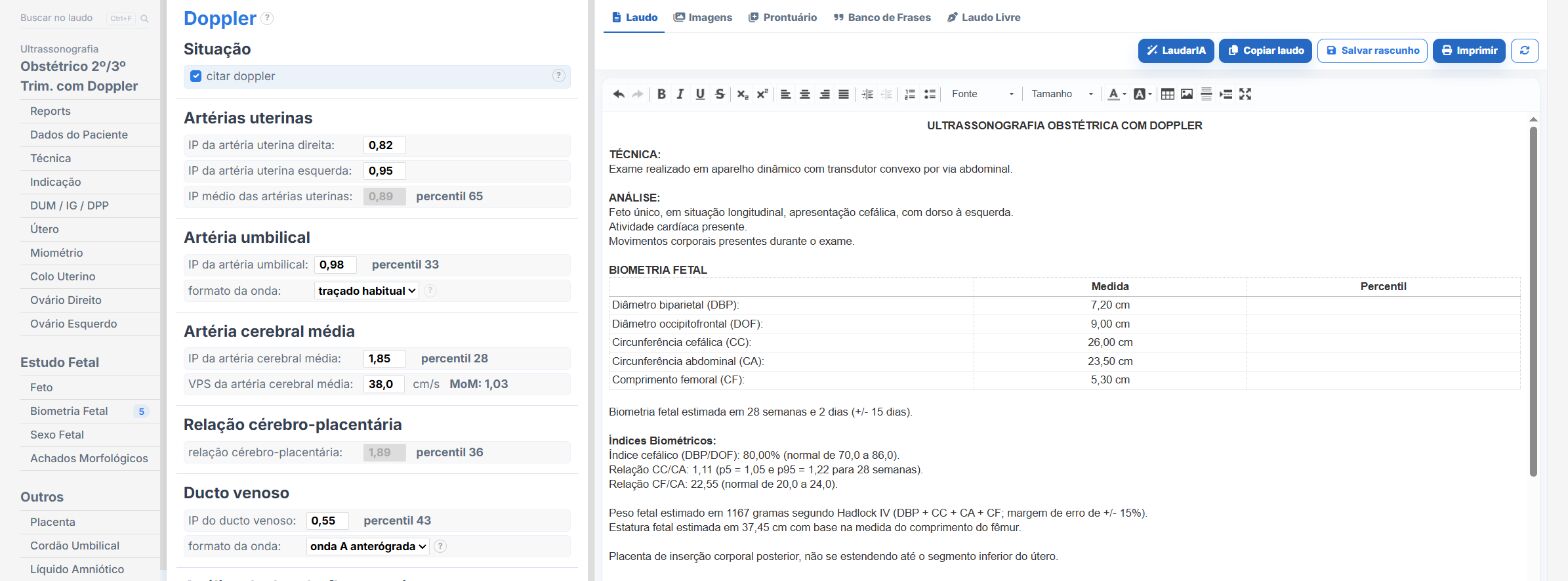
In the obstetric templates of Laudário:
- Biometry, fetal weight, and Doppler percentiles calculated from the measurements.
- Growth charts in the report itself.
- Recommendations in their own tab.
Try it for 15 days free, no credit card required.
The ultrasound reporting platform built by sonologists. We write about reports, classifications and standardization from the real routine of the practice. Who writes and how.
Educational content for healthcare professionals. It does not replace clinical judgment or the guidelines adopted by your service. Editorial policy.