Uterine artery Doppler in first-trimester preeclampsia screening: technique and report
How to obtain the uterine artery pulsatility index at 11 to 13 weeks, why it is not enough on its own, how it enters the combined risk calculation and what the report should include.
 LaudárioUltrasound reports in practice
This article is part of the guide Obstetric ultrasound: the three-trimester guide, from dating to Doppler.
First-trimester preeclampsia screening has changed how uterine artery Doppler is viewed. On its own, the pulsatility index has limited performance. Combined with maternal history, mean arterial pressure and, when available, placental growth factor (PlGF), it makes up the Fetal Medicine Foundation (FMF) screening, which identifies most patients who will develop early-onset preeclampsia.
Technique
- Between 11 and 13 weeks and 6 days, in the same exam as the nuchal translucency.
- Transabdominal approach: midsagittal view of the uterus and cervical canal, then lateral displacement of the transducer until the uterine artery is located next to the internal cervical os, using color Doppler.
- Insonation angle less than 30 degrees, sample volume of about 2 mm covering the vessel and at least three similar waveforms.
- The pulsatility index (PI) is measured in both arteries, and the mean PI is used.
Measuring at another point along the course, such as in the arcuate branches, gives different values and invalidates comparison with the references.
Why PI alone is not enough
PI varies with gestational age and with maternal characteristics, which is why it is expressed in multiples of the median (MoM). In the FMF algorithm, it is combined with age, weight, ethnicity, history, method of conception, mean arterial pressure and PlGF. The result is an individual risk, not an "abnormal Doppler".
What to do with a high risk
In the ASPRE trial, pregnant women at high risk on combined screening (above 1 in 100) who received low-dose acetylsalicylic acid, started before 16 weeks, had a significant reduction in preterm preeclampsia. Prescription and dose are the decision of the treating physician; the role of the report is to deliver the calculated risk clearly.
What the report should include
- PI of the right uterine artery, of the left and the mean PI.
- The mean PI in MoM, when the software provides it.
- Mean arterial pressure and PlGF used in the calculation, when applicable.
- The risk of preeclampsia before 34 and before 37 weeks, with the name of the algorithm.
- Classification as high or low risk by the cutoff adopted.
Common errors
- Measuring far from the internal cervical os.
- Reporting "abnormal uterine artery Doppler" without the combined calculation.
- Giving the risk without stating which algorithm was used.
- Forgetting to record the mean arterial pressure measured at the exam.
See also our article on first-trimester obstetric ultrasound.
How Laudário helps
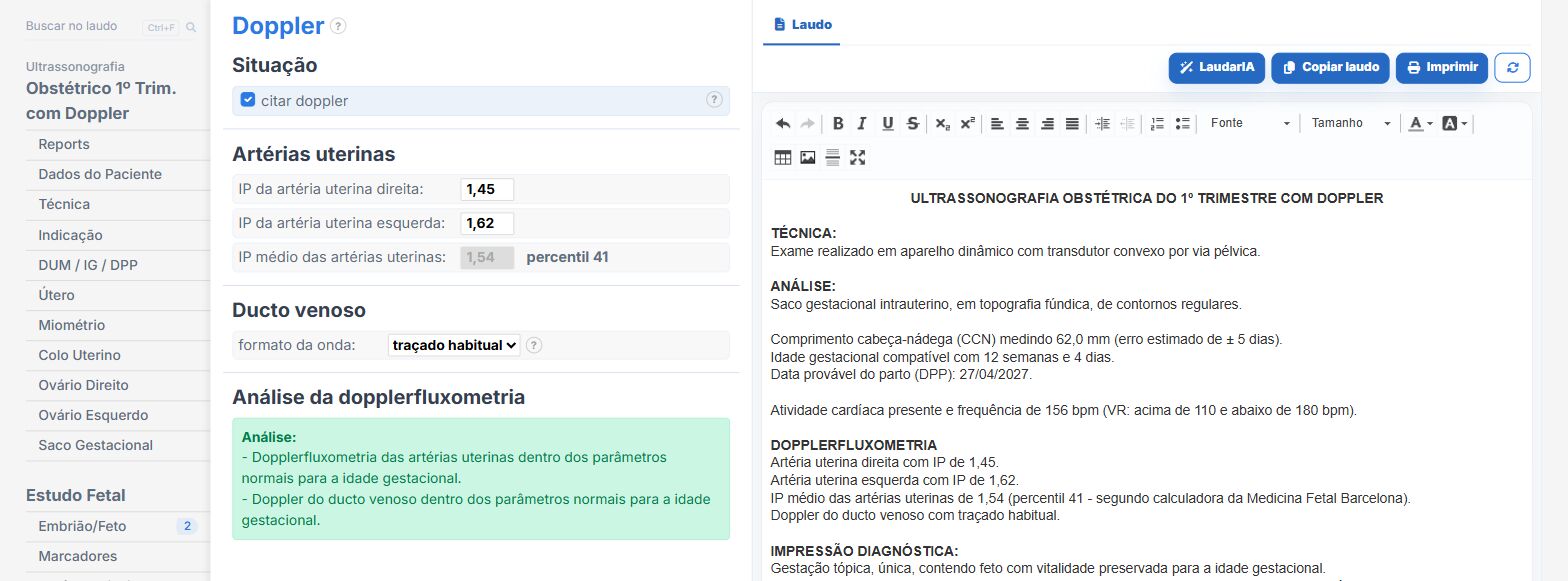
In the obstetric and first-trimester anatomy templates of Laudário:
- PI of the right and left uterine arteries, with the mean PI calculated.
- Preeclampsia risk calculation using the FMF algorithm, integrated into the first-trimester report.
- Trisomy and preeclampsia risk in the same report.
Try it free for 15 days, no credit card required.
The ultrasound reporting platform built by sonologists. We write about reports, classifications and standardization from the real routine of the practice. Who writes and how.
Educational content for healthcare professionals. It does not replace clinical judgment or the guidelines adopted by your service. Editorial policy.