Ectopic pregnancy on ultrasound: adnexal signs, hemoperitoneum and atypical locations
An empty uterus is not an ectopic pregnancy. The mass separate from the ovary, the tubal ring, fluid in the hepatorenal space and interstitial, cervical and cesarean scar ectopics, with wording for each scenario.
 LaudárioUltrasound reports in practice
This article is part of the guide Obstetric ultrasound: the three-trimester guide, from dating to Doppler.
Ectopic pregnancy remains an important cause of maternal death in the first trimester, and transvaginal ultrasound is the exam that finds it. It is also an emergency exam, often done at night, in a patient with pain and bleeding, in which the report needs to be fast and unequivocal: are there signs of ectopic pregnancy or not, is there blood in the cavity or not.
This article brings together the direct and indirect signs, the atypical locations and how to write the report for each scenario.
The starting point: the uterus
The first question is whether an intrauterine pregnancy exists. The presence of a gestational sac with a yolk sac or embryo inside the uterus makes ectopic pregnancy very unlikely, except in heterotopic pregnancy (intrauterine and extrauterine at the same time), which is rare in spontaneous conception but much more frequent in assisted reproduction.
An empty uterus with a positive beta-hCG is not synonymous with ectopic pregnancy. It may be a very early pregnancy or a complete loss. This is why the exam must actively look for adnexal signs.
Adnexal signs
Most ectopic pregnancies are tubal, especially in the ampulla. The findings, from most to least specific:
- Extrauterine gestational sac with embryo and cardiac activity: definitive diagnosis.
- Sac with a yolk sac outside the uterus.
- Tubal ring ("bagel" sign): echogenic ring with an anechoic center, separate from the ovary.
- Heterogeneous adnexal mass ("blob sign"), separate from the ovary: the most common finding, representing hematosalpinx and trophoblast.
The detail that avoids the most common mistake: the mass must be separate from the ovary. The corpus luteum is intraovarian and moves together with the ovary when pressed with the transducer; a tubal ectopic moves separately (sliding sign). Mistaking a corpus luteum for an ectopic pregnancy, and the reverse, is frequent.
Doppler may show the ring of fire around the mass, but the corpus luteum has the same pattern, so this sign alone does not differentiate the two.
Free fluid and hemoperitoneum
Free pelvic fluid is described by amount and appearance:
- A small amount of anechoic fluid in the cul-de-sac may be physiologic.
- Fluid with debris or echogenic fluid suggests blood.
- Fluid in the hepatorenal space (Morison pouch) indicates large-volume hemoperitoneum, a sign of severity that calls for immediate surgical evaluation.
In a patient with pain and suspected rupture, assessing the hepatorenal space is a mandatory part of the exam, and the finding should open the diagnostic impression.
Atypical locations
- Interstitial (cornual): sac in the intramural portion of the tube, eccentric, with thin myometrium around it (less than 5 mm). It ruptures later and with more severe bleeding. The interstitial line sign (the echogenic line of the endometrium reaching the sac) helps.
- Cervical: sac in the cervix, below the internal os, with peritrophoblastic flow. The differential is an abortion in progress, in which the sac is deformed, has no flow and moves with pressure (sliding sign).
- Cesarean scar: sac implanted in the scar, in the anterior wall of the isthmus, with thin myometrium between the sac and the bladder. Increasingly frequent, with a risk of rupture and accreta. The report should measure the thickness of the residual myometrium.
- Ovarian and abdominal: rare.
How to write the report
- Uterus: presence or absence of an intrauterine gestational sac, endometrial thickness, pseudosac.
- Adnexa: each ovary and the adnexal mass (location, relationship to the ovary, measurements, content, sac, yolk sac, embryo, cardiac activity).
- Free fluid: amount, appearance and presence in the hepatorenal space.
- Clear diagnostic impression: findings consistent with ectopic pregnancy (with location and whether there are signs of rupture), pregnancy of unknown location or intrauterine pregnancy.
- Recommendation in its own tab: correlation with the beta-hCG curve and follow-up, or immediate gynecologic evaluation.
In the setting of large-volume hemoperitoneum, the report should be communicated directly to the treating physician, in addition to being written.
Common errors
- Calling a corpus luteum an ectopic pregnancy, or the reverse.
- Concluding ectopic pregnancy from an empty uterus alone.
- Not assessing the hepatorenal space when rupture is suspected.
- Not measuring the residual myometrium in a cesarean scar pregnancy.
- Not recommending follow-up in a pregnancy of unknown location.
See also our article on early pregnancy and viability criteria.
How Laudário helps
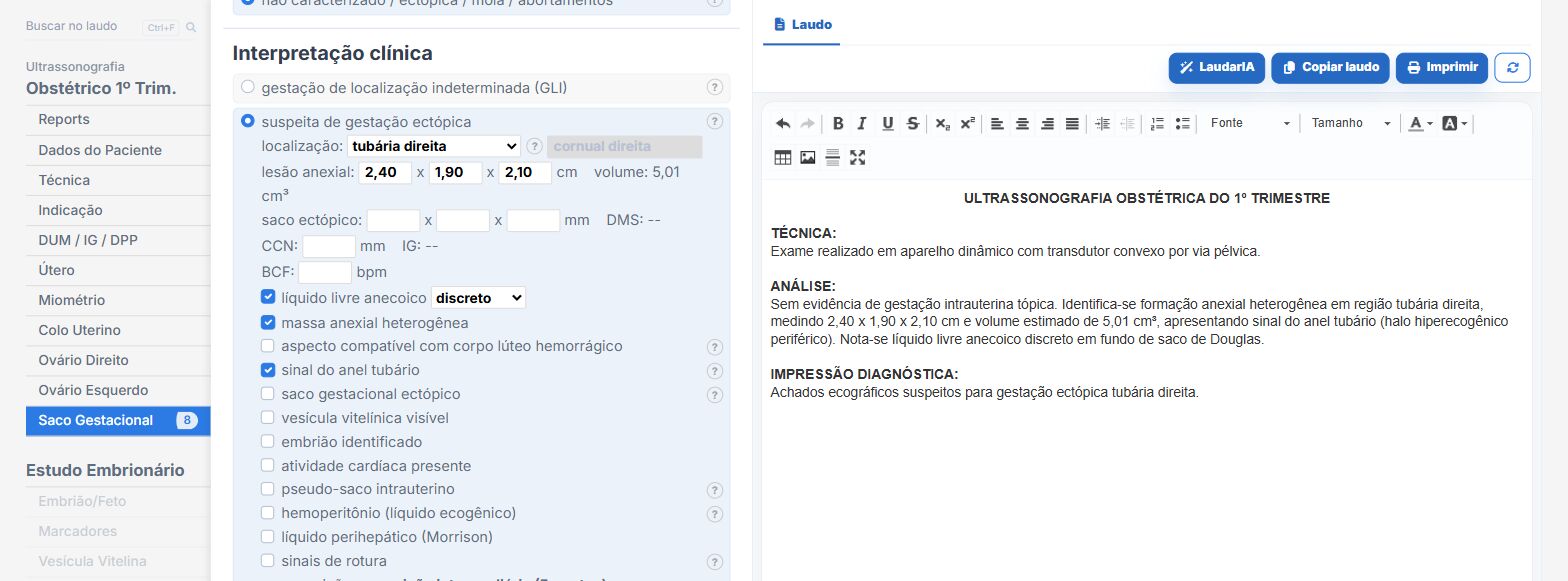
In the first-trimester obstetric and pelvic templates of Laudário:
- Ectopic pregnancy with location and findings in dedicated fields.
- Free fluid with amount and appearance.
- Diagnostic impression and recommendations built from what was selected.
Try it free for 15 days, no credit card required.
The ultrasound reporting platform built by sonologists. We write about reports, classifications and standardization from the real routine of the practice. Who writes and how.
Educational content for healthcare professionals. It does not replace clinical judgment or the guidelines adopted by your service. Editorial policy.