Early Pregnancy Ultrasound: Gestational Sac, Anembryonic Pregnancy and Viability Criteria
The definitive criteria for pregnancy failure (CRL of 7 mm without a heartbeat, 25 mm sac without an embryo), findings that are only suspicious, pregnancy of unknown location and how to write each scenario without error.
 LaudárioUltrasound reports in practice
This article is part of the guide Obstetric ultrasound: the three-trimester guide, from dating to Doppler.
Few reports carry as much emotional weight as the first ultrasound of a pregnancy. And few have such serious consequences when poorly written: declaring a pregnancy nonviable too early can lead to termination of a pregnancy that would have progressed normally. That is why the criteria for nonviability were revised and made more conservative, and the report must follow them to the letter.
This text walks through the structures of early pregnancy, the definitive and suspicious criteria for pregnancy failure and how to write each situation.
The normal sequence
By the transvaginal route, the structures appear in a predictable order:
- Gestational sac from about 4 to 5 weeks: eccentric anechoic collection in the endometrium, with an echogenic halo (decidual reaction).
- Yolk sac at around 5 to 5.5 weeks: it is the first structure that confirms the sac is truly gestational and intrauterine.
- Embryo with cardiac activity at around 6 weeks.
The report should measure the mean sac diameter (average of the three internal diameters) and the embryo's crown-rump length (CRL), and record the presence of the yolk sac and of cardiac activity, with the heart rate.
Definitive criteria for pregnancy failure
The Society of Radiologists in Ultrasound criteria, widely adopted, are highly specific, precisely to avoid false positives. Any one of them defines pregnancy failure:
- CRL of 7 mm or more without cardiac activity.
- Mean sac diameter of 25 mm or more without an embryo (the so-called anembryonic pregnancy, or "blighted ovum").
- Absence of an embryo with cardiac activity 2 weeks or more after an exam that showed a gestational sac without a yolk sac.
- Absence of an embryo with cardiac activity 11 days or more after an exam that showed a gestational sac with a yolk sac.
Outside these criteria, pregnancy failure should not be concluded on a single exam.
Suspicious but not definitive findings
Some findings raise suspicion and justify repeating the exam in 7 to 14 days, without concluding nonviability:
- CRL below 7 mm without cardiac activity.
- Mean sac diameter between 16 and 24 mm without an embryo.
- Absence of an embryo 6 weeks or more after the last menstrual period.
- Empty amnion (amnion visible without an embryo).
- Enlarged yolk sac, above 7 mm.
- Small gestational sac relative to the embryo (difference of less than 5 mm between the sac diameter and the CRL).
- Low embryonic heart rate (bradycardia).
In these cases, the diagnostic impression is "pregnancy of uncertain viability" or "suspicious findings", with a recommendation for sonographic follow-up on a defined date.
Pregnancy of unknown location
With a positive beta-hCG and no gestational sac visible in the uterus and no adnexal mass, the pregnancy is of unknown location. It may be a very early intrauterine pregnancy, an already complete loss or an ectopic pregnancy. The report should not state any of the three: it should describe the uterus, the adnexa and the free fluid and recommend correlation with the beta-hCG curve and a repeat exam.
It is also important not to call any intrauterine collection a gestational sac. The pseudosac of ectopic pregnancy is a central collection, without a double ring and without a yolk sac.
How to write the report
- Gestational sac: location (orthotopic, intrauterine), mean diameter, shape and decidual reaction.
- Yolk sac: present or absent, with diameter when abnormal.
- Embryo: CRL, cardiac activity and rate.
- Gestational age by CRL (or by the sac, before the embryo) and comparison with the date of the last menstrual period.
- Subchorionic hematoma, when present, with measurements.
- Adnexa and free fluid.
- Diagnostic impression with one of the categories: viable intrauterine pregnancy, of uncertain viability, pregnancy failure (citing the criterion) or of unknown location.
When the failure criterion is met, citing it verbatim ("mean gestational sac diameter of 27 mm without an embryo") gives confidence to the treating physician and to the patient.
Common errors
- Concluding "anembryonic pregnancy" with a sac below 25 mm on a single exam.
- Concluding embryonic demise with a CRL below 7 mm on a single exam.
- Calling a collection without a yolk sac a gestational sac.
- Not recommending follow-up in indeterminate cases.
- Dating by the menstrual period when the CRL is available.
See also our text on the first-trimester report.
How Laudário helps
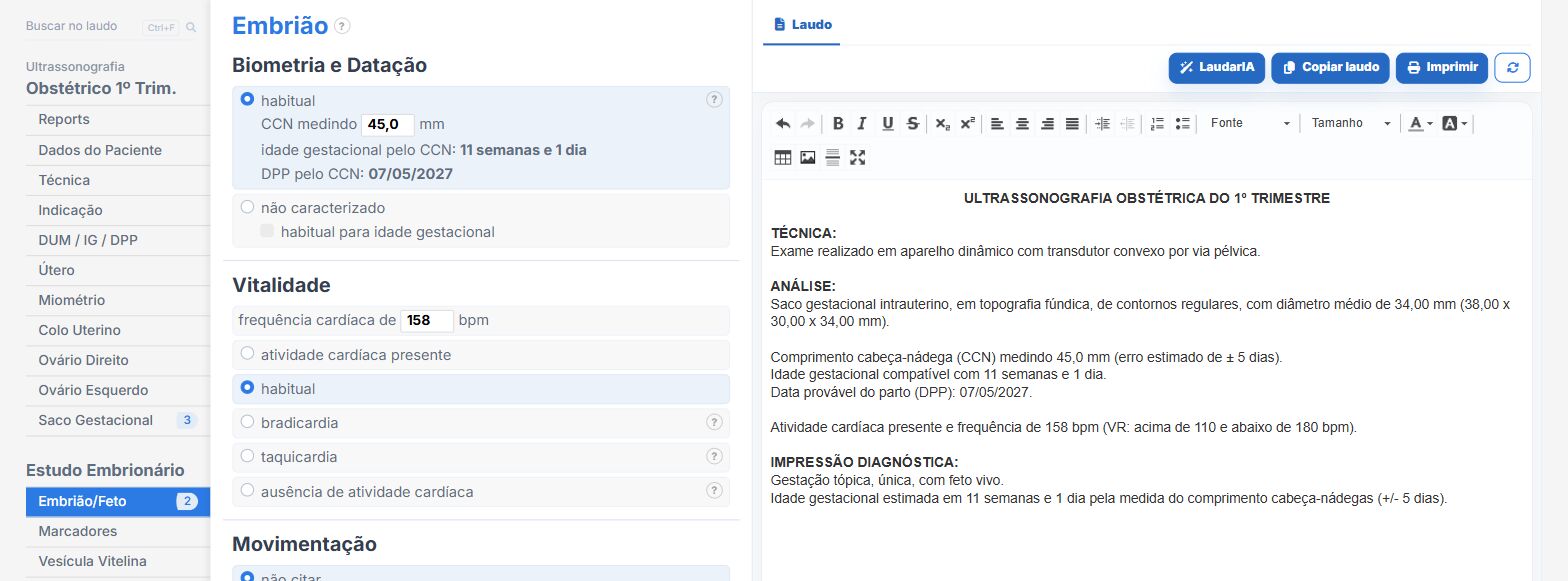
The first-trimester obstetric template in Laudário covers early pregnancy. In practice:
- Mean sac diameter and CRL with the gestational age calculated.
- Yolk sac, cardiac activity and heart rate in their own fields.
- Anembryonic pregnancy and subchorionic hematoma with ready-made phrases.
- Follow-up recommendation in its own tab.
Try it for 15 days free, no credit card.
The ultrasound reporting platform built by sonologists. We write about reports, classifications and standardization from the real routine of the practice. Who writes and how.
Educational content for healthcare professionals. It does not replace clinical judgment or the guidelines adopted by your service. Editorial policy.