Amniotic fluid on ultrasound: AFI or deepest vertical pocket, and how to report oligohydramnios and polyhydramnios
How to measure the amniotic fluid index and the deepest vertical pocket, why the pocket is preferred for diagnosing oligohydramnios, the cutoffs, and the grading of polyhydramnios.
 LaudárioUltrasound reports in practice
This article is part of the guide Obstetric ultrasound: the three-trimester guide, from dating to Doppler.
Amniotic fluid assessment is part of every obstetric ultrasound from the second trimester on, and the way it is measured changes the diagnosis. Two methods are used: the amniotic fluid index (AFI) and the deepest vertical pocket (DVP). The report should say which was used and the value found, not just "normal fluid."
How to measure
- Deepest vertical pocket: the deepest vertical column of fluid free of fetal parts and cord, measured with the transducer perpendicular to the floor. A minimum width of 1 cm is required for the pocket to count.
- AFI: the uterus is divided into four quadrants, using the linea nigra and the umbilicus; the deepest vertical pocket of each quadrant is measured and the four are added.
Color Doppler helps exclude cord loops that look like fluid. Excessive transducer pressure reduces the measurement.
Oligohydramnios
The most commonly used cutoffs are DVP less than 2 cm or AFI of 5 cm or less. Systematic reviews have shown that using the AFI to diagnose oligohydramnios increases the number of diagnoses and labor inductions without improving perinatal outcomes. For that reason, societies such as ACOG prefer the deepest vertical pocket for this diagnosis.
In the face of oligohydramnios, the report should recall the causes to investigate: rupture of membranes, placental insufficiency with growth restriction, fetal urinary tract anomalies, and post-term pregnancy.
Polyhydramnios
The cutoffs are DVP of 8 cm or more or AFI of 24 cm or more (some services use 25 cm). The most cited grading is:
- Mild: DVP of 8 to 11 cm or AFI of 24 to 29.9 cm.
- Moderate: DVP of 12 to 15 cm or AFI of 30 to 34.9 cm.
- Severe: DVP of 16 cm or more or AFI of 35 cm or more.
Most mild cases are idiopathic, but the finding warrants a fetal morphology review, with attention to the gastrointestinal tract and central nervous system, and correlation with gestational diabetes screening.
Twin pregnancy
In twin pregnancy, the deepest vertical pocket of each sac is measured. In monochorionic pregnancies, discordance with oligohydramnios in one sac and polyhydramnios in the other is a criterion for twin-to-twin transfusion syndrome.
Common errors
- Reporting "normal amniotic fluid" without the method and the value.
- Including cord loops in the measurement.
- Diagnosing oligohydramnios by AFI and inducing labor unnecessarily.
- Using the total AFI in twin pregnancy.
See also the texts on third-trimester obstetric ultrasound and fetal biophysical profile.
How Laudário helps
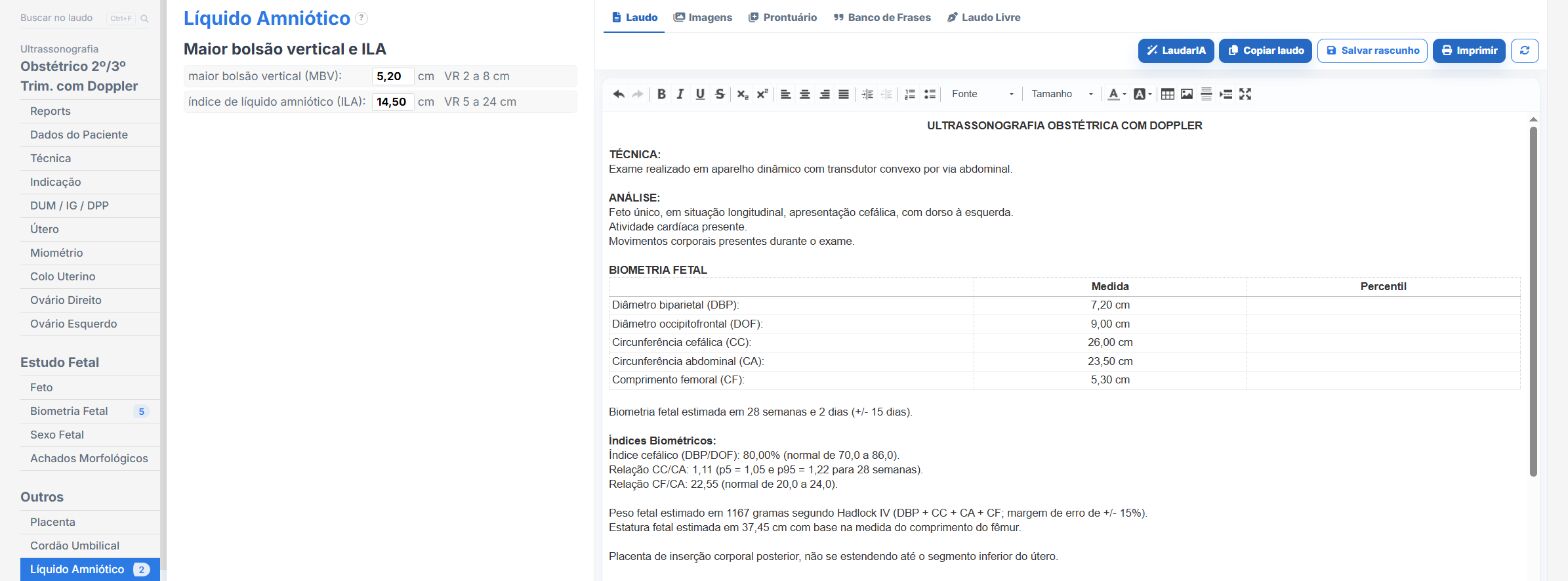
In the obstetric templates of Laudário:
- AFI calculated from the four quadrants and deepest vertical pocket in its own field.
- Classification of oligohydramnios and polyhydramnios from the measured value.
- Per-fetus fields in twin pregnancy.
Try it for 15 days free, no credit card required.
The ultrasound reporting platform built by sonologists. We write about reports, classifications and standardization from the real routine of the practice. Who writes and how.
Educational content for healthcare professionals. It does not replace clinical judgment or the guidelines adopted by your service. Editorial policy.