Fetal biophysical profile: how to structure the report for fetal well-being assessment
The fetal biophysical profile (BPP) is one of the most widely used exams for assessing fetal well-being in the third trimester, mainly in high-risk pregnancies (hypertension, diabetes, growth restriction, post-term pregnancy, and decreased fetal movement reported by the patient). It combines par...
 LaudárioUltrasound reports in practice
This article is part of the guide Obstetric ultrasound: the three-trimester guide, from dating to Doppler.
The fetal biophysical profile (BPP) is one of the most widely used exams for assessing fetal well-being in the third trimester, mainly in high-risk pregnancies (hypertension, diabetes, growth restriction, post-term pregnancy, and decreased fetal movement reported by the patient). It combines acute and chronic markers of fetal well-being in a single ultrasound window and, together with cardiotocography, helps the obstetrician choose between expectant management, early delivery, or hospital admission. For that reason, the report must be clear, objective, and standardized: each component assessed should be described in a reproducible way, with the final score and the clinical interpretation stated explicitly.
Why standardize the fetal biophysical profile report
The BPP is a short exam to perform, but it carries great responsibility. In a few minutes of observation, the sonologist must score fetal breathing movements, gross body movements, fetal tone, and amniotic fluid volume, adding cardiotocography when applicable. Each item has its own criterion, a defined time window, and a direct impact on the final score (0 to 10), which guides immediate obstetric management.
Without standardization, reports commonly contain generic descriptions such as “fetal movements present” or “adequate amount of amniotic fluid,” without stating the criterion used. This compromises reproducibility between examiners, makes it harder to compare serial exams over time, and can leave the referring obstetrician with questions. A well-structured report describes each parameter, scores it according to the Manning protocol, and concludes with the total and the clinical interpretation.
Components of the fetal biophysical profile
The classic BPP, proposed by Manning, assesses five parameters: four ultrasonographic and one electronic (cardiotocography). In many settings, the exam is performed with the ultrasonographic parameters alone (modified BPP, or 8-point BPP), and the report should make clear which version was performed.
- Fetal breathing movements (FBM): at least one episode of breathing movement lasting a minimum of 30 seconds within 30 minutes of observation.
- Gross body movements (GBM): three or more body or limb movements in 30 minutes.
- Fetal tone: at least one episode of active extension with return to flexion of the trunk or limbs, or opening and closing of the hand.
- Amniotic fluid volume (AFV): at least one deepest vertical pocket of 2 cm or more in two perpendicular dimensions, or an AFI within the normal range according to the service protocol.
- Cardiotocography (CTG): reactive tracing, with at least two fetal heart rate accelerations in 20 minutes.
Each component receives 2 points when the criterion is fully met and 0 points when it is not observed within the time window. No intermediate score is used. This point, however obvious it may seem, should be absolutely clear in the body of the report to avoid ambiguous interpretations.
How to structure the exam identification
Before describing the parameters themselves, the report should include data that contextualize the interpretation: gestational age by LMP and by the earliest ultrasound, singleton or multiple pregnancy, fetal position, placental location, and any relevant clinical information (suspected growth restriction, previous oligohydramnios, reduced movements, maternal disease). When the exam is performed on a patient who already has prior BPPs, it is worth recording the evolution by citing the previous score and date.
The gestational age description needs to be careful: many BPPs are performed in pregnancies whose dating is uncertain or discordant, and this affects the interpretation of fluid volume and the associated biometry. Whenever possible, state explicitly which gestational age was adopted for the analysis.
Describing the biophysical parameters
Fetal breathing movements
Describe whether or not breathing movements were observed during the assessment window, specifying the total observation time. When present, record that there was at least one episode lasting 30 seconds or longer, meeting the criterion for 2 points. When absent or intermittent, state clearly that the criterion was not met (0 points) and consider reporting factors that may have influenced it, such as apparent fetal sleep, early gestational age, or maternal medication use.
Gross body movements
Count and describe the body and limb movements observed throughout the exam. The scoring criterion is the presence of at least three discrete movements in 30 minutes. Continuous movements over long periods count as a single event. The report should reflect the number observed and the conclusion about the score assigned.
Fetal tone
Describe whether at least one episode of extension followed by full flexion of the trunk or limbs was observed, or opening and closing of the hand. Simply maintaining a flexed position, without evidence of active movement, is not sufficient. This parameter tends to be the last to change in chronic hypoxemia, so its absence usually indicates greater severity and deserves emphasis in the conclusion.
Amniotic fluid volume
This is the most sensitive parameter for chronic hypoxia and the one that most often lowers the BPP score. Document the method used: deepest vertical pocket (DVP) or amniotic fluid index (AFI). To score 2, the classic criterion is a DVP of 2 cm or more in two perpendicular dimensions; lower values characterize oligohydramnios and zero this item. In multiple pregnancies, describe the fluid of each gestational sac separately.
In comparative reports, record the trend: stability, reduction, or increase in volume relative to the previous exam. This information alone already directs obstetric management in several scenarios.
Cardiotocography (when included)
When the service combines CTG with the BPP, the report should state whether the tracing was reactive or nonreactive, based on the criterion of accelerations within 20 minutes. In purely ultrasonographic reports, make clear that CTG was not performed and that the score corresponds to the modified BPP (8 points).
Final score and clinical interpretation
The conclusion of the report should give the explicit sum of points, the interpretation according to the Manning protocol, and an objective statement of how reassuring the exam is. As a practical reference:
- 8/8 or 10/10: normal biophysical profile, with low risk of fetal hypoxia at the time of the exam.
- 6/8 or 6/10: equivocal result; it usually requires repeat assessment after a short interval and clinical contextualization.
- 4/8 or 4/10: suspicious for fetal hypoxia; obstetric management should be active, taking gestational age and clinical scenario into account.
- 2/10 or 0/10: high probability of fetal compromise, with the usual indication for early delivery.
It is important to state in the report that the interpretation of the BPP is always combined with the maternal clinical picture, gestational age, biometry, obstetric Doppler (when available), and the clinical course. The sonologist does not manage the pregnancy, but the report must give the obstetrician all the information needed for decision-making.
Findings that deserve emphasis in the conclusion
- Oligohydramnios, even when the other BPP parameters score 8/8: it signals chronic hypoxia and demands attention.
- Discordant scores between serial exams over a short interval.
- Absence of fetal tone, considered a late and more serious marker.
- Persistently absent breathing movements in pregnancies near term.
- Significant discordance between the BPP and obstetric Doppler, when both were assessed.
When these points are highlighted clearly, they help the obstetrician prioritize the case and keep subtle findings from getting lost in a long report.
Precautions to avoid ambiguous reports
- Avoid generic descriptions such as “preserved well-being” without detailing the parameters and the score.
- Always record the actual observation time of the exam; very short BPPs have reduced sensitivity for detecting absent movements.
- State clearly whether the exam was a complete BPP (10 points) or modified (8 points, without CTG).
- Distinguish absolute oligohydramnios from fluid at the lower limit of normal, since they call for different management.
- Include, whenever possible, the comparison with the previous exam.
How Laudário helps structure the fetal biophysical profile report
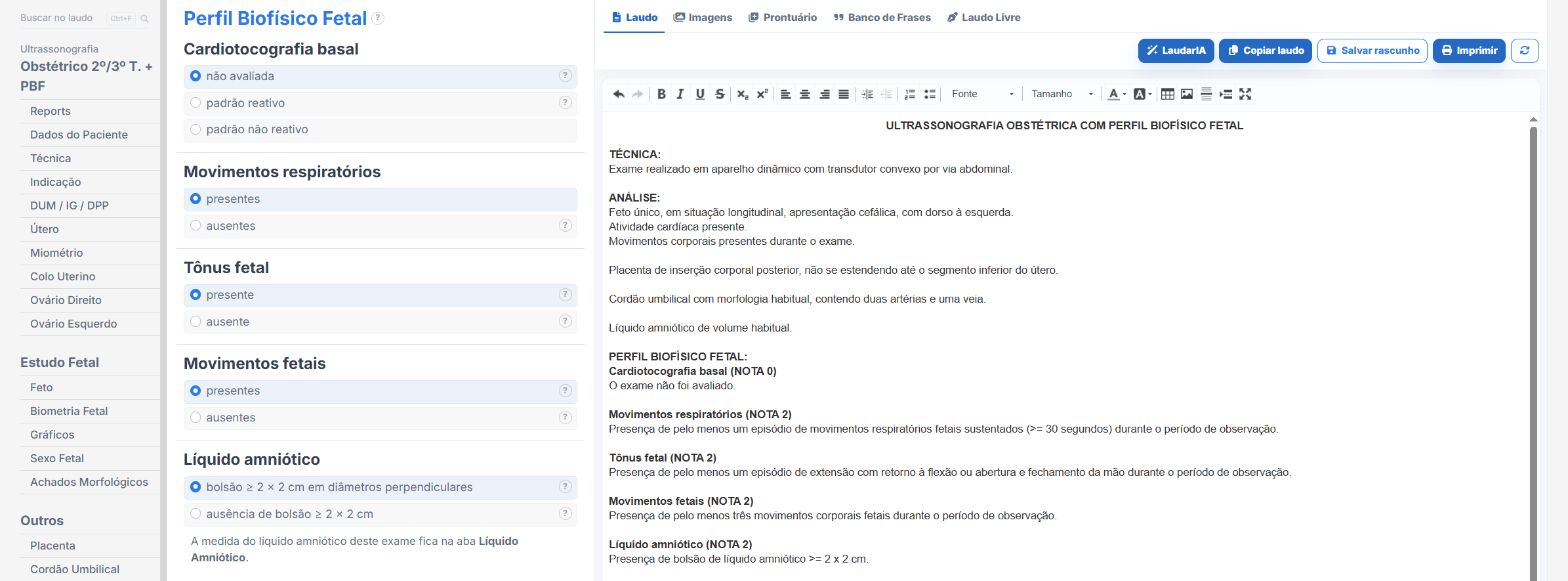
Laudário was developed to speed up report typing without giving up the clinical depth that exams such as the fetal biophysical profile require. Within the system, the BPP template already comes with the complete Manning protocol structure, with ready-made fields to describe each parameter, record the score assigned, and automatically generate the final total and the standardized clinical interpretation.
In practice, this means:
- A ready structure to describe breathing movements, body movements, tone, and amniotic fluid, with standardized phrases that can be adjusted to your reporting style.
- Automatic calculation of the total score, avoiding addition errors and discrepancies between the body of the report and the conclusion.
- Integration with the other obstetric templates (second and third trimester obstetric, obstetric Doppler, cervical length measurement), favoring consistency between serial exams of the same patient.
- Professional printing with a QR code and a digital version of the report, adding traceability and more perceived value in the final delivery to the patient and the obstetrician.
- Support from LaudarIA, the integrated artificial intelligence, to help build phrases, conclusions, and fine adjustments to the text.
The result is a standardized BPP report that is quick to produce and, above all, more useful to the obstetrician who receives it. In a high-volume ultrasound practice, saving seconds per report and standardizing clinical communication means less rework, more productivity, and better quality in delivery.
If you are not familiar with it yet, it is worth trying: Laudário offers a 15-day free trial, no credit card required, with immediate access to all exam templates, including the fetal biophysical profile and the other protocols of routine obstetric and general ultrasound.
The ultrasound reporting platform built by sonologists. We write about reports, classifications and standardization from the real routine of the practice. Who writes and how.
Educational content for healthcare professionals. It does not replace clinical judgment or the guidelines adopted by your service. Editorial policy.