Antral follicle count on ultrasound: ovarian reserve and how to report it
When to perform the antral follicle count, which follicles are counted, how to interpret the total count when assessing ovarian reserve and what the report must tell the reproductive specialist.
 LaudárioUltrasound reports in practice
This article is part of the guide Gynecologic ultrasound: the complete guide, from uterus to ovaries.
The antral follicle count (AFC) is, alongside anti-Müllerian hormone, the main marker of ovarian reserve. It helps predict the response to ovarian stimulation and guides dose selection in assisted reproduction. It is a simple measurement, but one that depends on technique and on a report that states how it was done.
When to perform it
- In the early follicular phase, generally between days 2 and 5 of the cycle.
- By the transvaginal route, with a good-resolution transducer.
- The report should record the cycle day and whether the patient uses hormonal contraception, which reduces the count and can underestimate reserve.
What is counted
Follicles with a mean diameter of 2 to 10 mm are counted in each ovary, sweeping the entire ovary from one edge to the other so as not to count the same follicle twice. Larger follicles, functional cysts and the corpus luteum are not included in the count and should be described separately.
The result is reported per ovary and as a total count (the sum of both).
How to interpret
Cutoffs vary between studies and protocols, but in practice the total count is usually read as follows:
- Very low (up to about 4) and low (about 5 to 6): reduced reserve, with an expected low response to stimulation.
- Normal: about 7 to 19.
- High: 20 or more, with a risk of exaggerated response to stimulation and of ovarian hyperstimulation syndrome.
Per ovary, it is common to describe the pattern as oligofollicular (few follicles), normofollicular or multifollicular.
A high AFC is not synonymous with polycystic ovary syndrome. Polycystic morphology has its own criterion (follicle number per ovary and ovarian volume, with high-frequency transducers), and the diagnosis of the syndrome also depends on clinical and laboratory evaluation.
Other useful information
- Volume of each ovary.
- Cysts, endometriomas or other lesions that may limit the count.
- A difficult-to-access ovary (high, retrouterine), which is a technical limitation and should be cited.
- Endometrial thickness and appearance, when the study is part of preparation for treatment.
Common errors
- Not stating the cycle day or the use of contraception.
- Counting follicles larger than 10 mm or cysts as antral follicles.
- Reporting only the total, without the count for each ovary.
- Calling a high count "polycystic ovaries" without the criteria.
- Omitting that one of the ovaries was poorly visualized.
See also our articles on polycystic ovaries and on hysterosonography and HyCoSy in infertility.
How Laudário helps
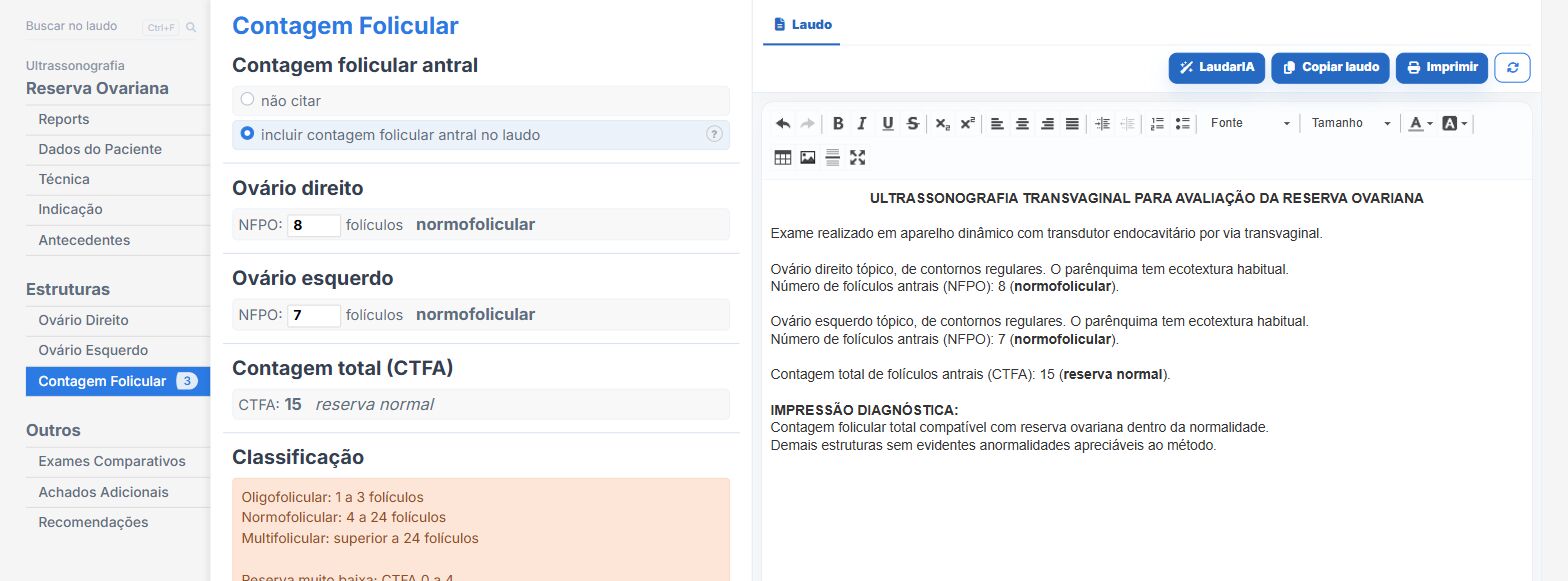
In the ovarian reserve assessment template of Laudário:
- Number of follicles per ovary, with the pattern (oligo-, normo- or multifollicular) classified on the spot.
- Total count summed and classified automatically.
- Ovaries, history and indication in the same tabs as the transvaginal report.
Try it free for 15 days, with no credit card.
The ultrasound reporting platform built by sonologists. We write about reports, classifications and standardization from the real routine of the practice. Who writes and how.
Educational content for healthcare professionals. It does not replace clinical judgment or the guidelines adopted by your service. Editorial policy.