Ovarian torsion on ultrasound: the signs that matter and why normal Doppler does not exclude it
Enlarged and edematous ovary, peripheral follicles, whirlpool sign and associated mass: the findings that support the suspicion, the Doppler pitfalls and how to write an urgent report.
 LaudárioUltrasound reports in practice
This article is part of the guide Gynecologic ultrasound: the complete guide, from uterus to ovaries.
Ovarian torsion is an emergency in which the time to surgery determines whether the ovary will be preserved. Ultrasound is the first study, and the report needs to be clear: it either supports the suspicion or it does not. The most dangerous error is reassuring the team because "there is flow on Doppler".
The findings that support the suspicion
- Enlarged ovary, with volume clearly greater than the contralateral one. It is the most consistent finding.
- Edematous and heterogeneous stroma, with follicles displaced to the periphery.
- Associated mass, which acts as a lead point: functional cysts, mature teratoma and other adnexal lesions, generally above 5 cm.
- Whirlpool sign: the twisted vascular pedicle, seen as a rounded spiral structure, with the vessels swirling on Doppler. It is one of the most specific signs.
- Abnormal position of the ovary, for example in the midline or above the uterus.
- Free fluid in the pelvis.
Doppler: the presence of flow does not exclude torsion
The ovary has a dual blood supply, from the ovarian and uterine arteries, and torsion can be partial or intermittent. Therefore, preserved arterial and venous flow is described in a significant proportion of torsions confirmed at surgery. Absence of venous flow, or of any flow, greatly strengthens the suspicion, but the presence of flow does not rule out the diagnosis when the clinical picture and morphology point to torsion.
Special situations
- Children and adolescents: torsion can occur in an ovary without an associated lesion.
- Pregnant women: the risk is higher in the first trimester, especially with a large corpus luteum cyst or after ovulation induction.
- Ovarian hyperstimulation: ovaries greatly enlarged by multiple cysts have an increased risk of torsion.
What to write
- Volume of both ovaries, for comparison.
- Appearance of the stroma, distribution of the follicles and associated mass, with measurements.
- Presence or absence of the whirlpool sign.
- Arterial and venous Doppler, described as a finding, without a conclusion of "torsion excluded".
- In the impression, when the findings support the suspicion: "findings consistent with adnexal torsion", with a recommendation for urgent gynecologic evaluation.
Urgent findings should be communicated directly to the treating team, in addition to being in the report.
Common errors
- Concluding "no signs of torsion" because there is flow on Doppler.
- Not measuring the contralateral ovary.
- Describing the adnexal mass and forgetting to evaluate the pedicle.
See also the texts on transvaginal pelvic ultrasound and O-RADS.
How Laudário helps
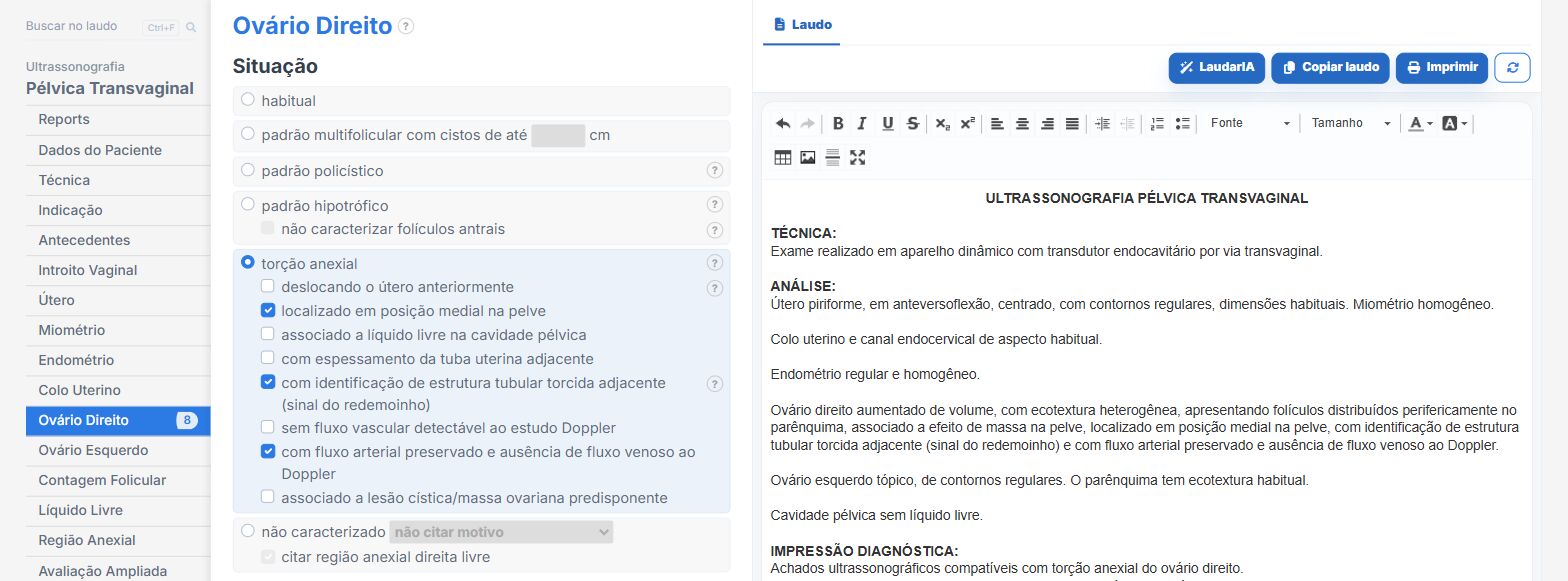
In the transvaginal and suprapubic female pelvis templates of Laudário:
- Ovarian volume calculated for both sides.
- Adnexal masses and Doppler in their own fields.
- Diagnostic impression and recommendations separate from the findings.
Try it for 15 days free, no credit card.
The ultrasound reporting platform built by sonologists. We write about reports, classifications and standardization from the real routine of the practice. Who writes and how.
Educational content for healthcare professionals. It does not replace clinical judgment or the guidelines adopted by your service. Editorial policy.