E-FAST in trauma: the windows, pneumothorax and how to document the exam
The E-FAST windows, how to look for free fluid in the abdomen and pericardium, signs of pneumothorax and hemothorax on thoracic ultrasound, the limitations of a negative exam and how to keep the documentation objective.
 LaudárioUltrasound reports in practice
This article is part of the guide Abdominal Ultrasound: A Guide to the Findings That Actually Change Management.
E-FAST (Extended Focused Assessment with Sonography for Trauma) is bedside ultrasound of the trauma patient. It does not try to diagnose every injury: it answers objective questions that change immediate management. Is there free fluid in the abdomen? Is there a pericardial effusion? Is there pneumothorax or hemothorax? The documentation of the exam should follow the same logic, window by window.
The FAST windows
- Right upper quadrant: hepatorenal space (Morison pouch), including the inferior tip of the liver, which is one of the most sensitive locations.
- Left upper quadrant: perisplenic and splenorenal region. Fluid tends to accumulate first above the spleen.
- Pelvis: retrovesical in men and pouch of Douglas in women, in transverse and longitudinal planes. A full bladder helps.
- Pericardium: subxiphoid window, or parasternal when the subxiphoid is not possible.
The thoracic extension
- Pneumothorax: search on the anterior chest wall, with the patient supine. Present pleural sliding rules out pneumothorax at that point. Absence of sliding suggests pneumothorax, and the lung point, where sliding reappears, confirms it. In M-mode, the barcode pattern replaces the seashore pattern.
- Hemothorax: fluid above the diaphragm in the upper quadrant windows.
Limitations
- Small amounts of fluid may not be seen.
- The exam does not evaluate the retroperitoneum well, nor solid organ injuries without bleeding.
- Obesity, subcutaneous emphysema and dressings limit the windows.
- A negative E-FAST does not exclude injury. In a stable patient, CT remains indicated according to the mechanism; in a patient who is deteriorating, the exam should be repeated.
How to document
- Time of the exam and the patient's condition, when relevant.
- Each window as positive, negative or indeterminate (not assessable), with the reason.
- Location of the fluid and a qualitative estimate of the amount.
- Pneumothorax result on each side.
- Objective conclusion: E-FAST positive for free fluid, pericardial effusion or pneumothorax, or negative in the windows evaluated.
- If it was repeated, comparison with the previous exam.
Common errors
- Documenting "negative FAST" when a window was not evaluated.
- Not examining the inferior tip of the liver in the right upper quadrant.
- Confusing pericardial fat with effusion.
- Using a negative exam to forgo CT in someone who has an indication.
- Not repeating the exam when the patient's condition changes.
See also our abdominal ultrasound guide.
How Laudário helps
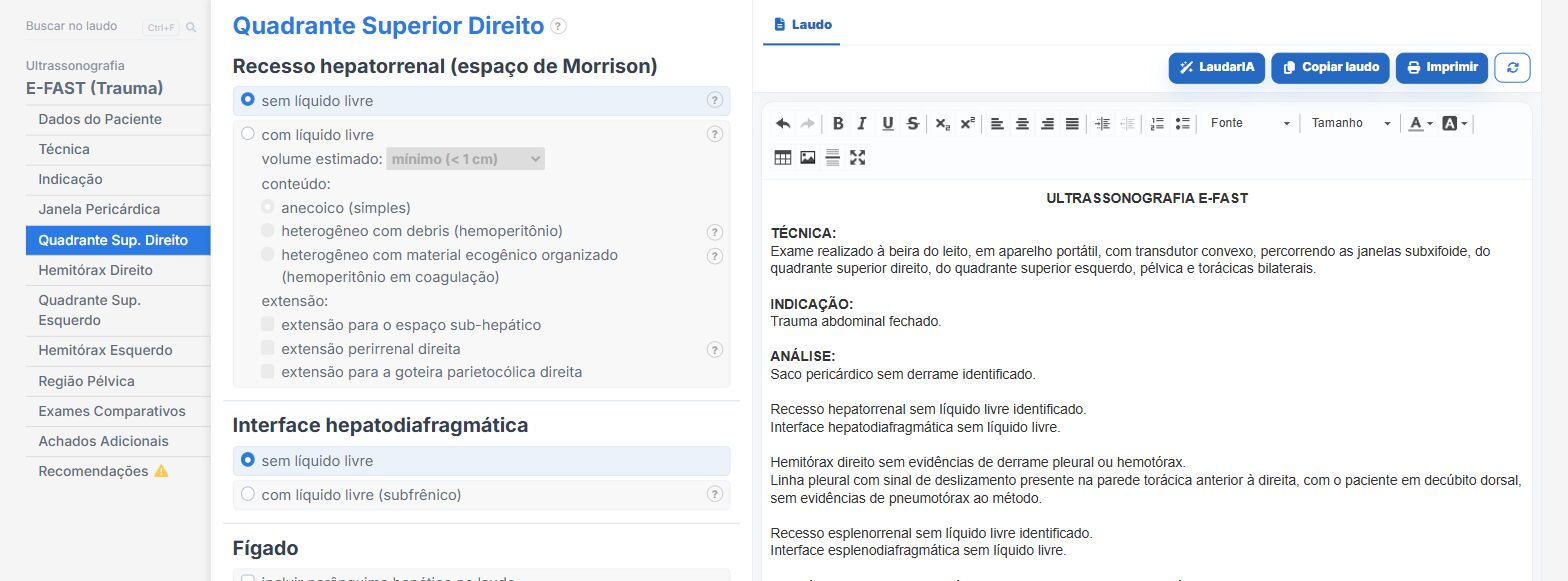
In the E-FAST template of Laudário:
- Each window with a positive, negative or not assessable result.
- Pneumothorax and hemothorax on each side in their own options.
- Conclusion built from the windows checked.
Try it for 15 days free, no credit card required.
The ultrasound reporting platform built by sonologists. We write about reports, classifications and standardization from the real routine of the practice. Who writes and how.
Educational content for healthcare professionals. It does not replace clinical judgment or the guidelines adopted by your service. Editorial policy.