Gynecomastia on ultrasound: the patterns, pseudogynecomastia and when to suspect cancer
How to distinguish true gynecomastia from pseudogynecomastia on ultrasound, what the nodular, dendritic and diffuse patterns are, the signs that raise suspicion for male breast cancer and how to apply BI-RADS in men.
 LaudárioUltrasound reports in practice
This article is part of the guide Standardized classifications in the report: a guide to BI-RADS, TI-RADS and O-RADS.
Breast enlargement in men is a frequent complaint and almost always benign. The role of ultrasound is to separate three situations with very different management: pseudogynecomastia (fat only), gynecomastia (proliferation of glandular tissue) and, rarely, male breast cancer.
Pseudogynecomastia
The volume is due to accumulation of adipose tissue, without retroareolar fibroglandular tissue. It is common in obesity. The report should state explicitly that there is no glandular tissue, because that is what reassures the patient and the physician.
Gynecomastia: the patterns
The glandular tissue appears in the retroareolar region, centered on the nipple. Three patterns are described, related to the duration of the condition:
- Nodular: fan-shaped or disc-shaped hypoechoic area behind the nipple, typical of the early phase (months).
- Dendritic: hypoechoic tissue with projections extending into the fat, related to the chronic phase, with fibrosis.
- Diffuse: appearance similar to the female breast, with more extensive echogenic fibroglandular tissue, generally associated with hormone use.
Gynecomastia is usually bilateral, even if asymmetric, and may be painful in the early phase. Common causes include puberty, aging, medications and hormonal changes, and investigation of the cause is clinical.
When to suspect cancer
Male breast cancer is rare, but it is usually diagnosed late. The following deserve attention:
- Eccentric nodule relative to the nipple, rather than centered on it.
- Noncircumscribed margins (irregular, spiculated or angular), nonparallel orientation.
- Internal vascularity on Doppler.
- Nipple retraction, skin thickening, bloody discharge.
- Axillary lymph nodes with a thickened cortex or loss of the hilum.
BI-RADS in men
BI-RADS also applies to the male breast. Typical gynecomastia and pseudogynecomastia are benign findings (category 2). A nodule with suspicious features should be classified as 4 or 5 and referred for biopsy. Mammography complements ultrasound when there is a nodule or doubt, especially from middle age onward.
What the report should include
- Side or bilaterality.
- Presence or absence of glandular tissue and the pattern (nodular, dendritic, diffuse).
- Measurements of the retroareolar tissue.
- Nodules, with their features per the BI-RADS lexicon.
- Axillae.
- BI-RADS category and recommendation.
Common errors
- Calling a fat-only enlargement gynecomastia.
- Describing nodular gynecomastia as a "nodule", leading to unnecessary biopsy.
- Not evaluating the axillae.
- Failing to classify with BI-RADS.
- Not highlighting the eccentric nodule.
See also our text on BI-RADS in breast ultrasound.
How Laudário helps
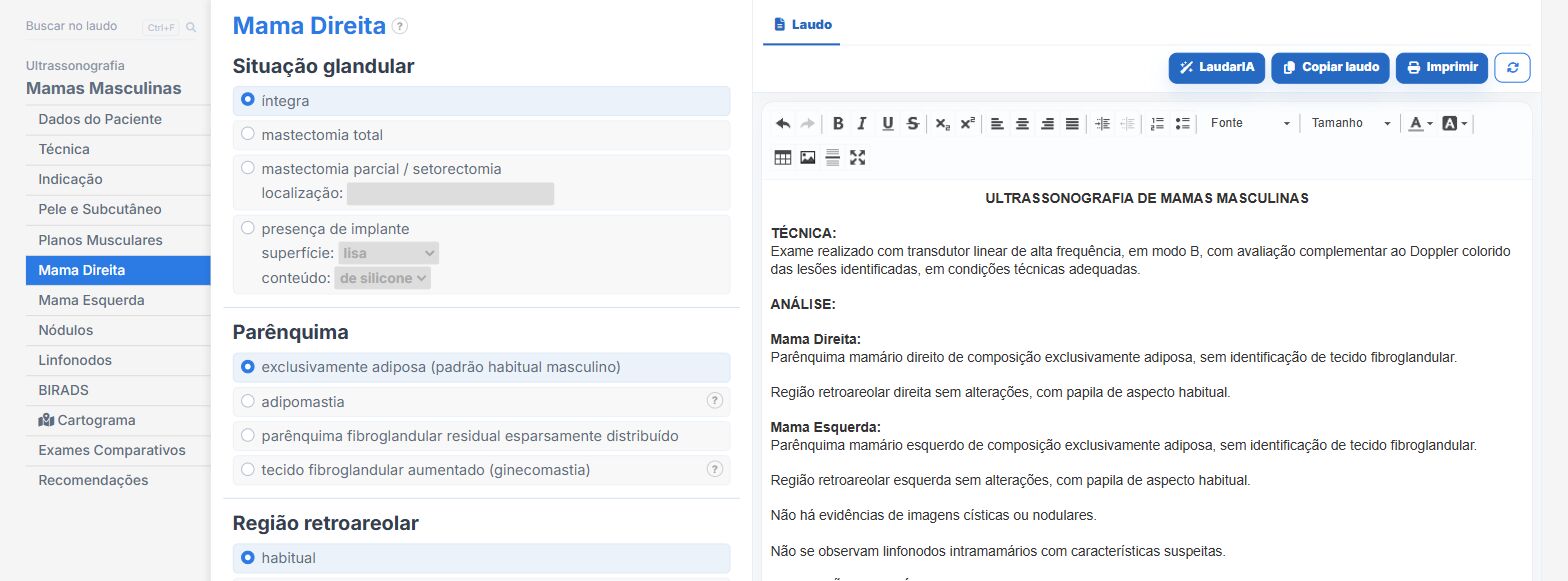
In the male breast template of Laudário:
- Breast with an adipose pattern (adipomastia), gynecomastia and the pattern as their own options, by side.
- Nodules described by the BI-RADS lexicon, with the category in the conclusion.
- Axillae and recommendations on their own tabs.
Try it for 15 days free, no credit card required.
The ultrasound reporting platform built by sonologists. We write about reports, classifications and standardization from the real routine of the practice. Who writes and how.
Educational content for healthcare professionals. It does not replace clinical judgment or the guidelines adopted by your service. Editorial policy.