Trisomy and Preeclampsia Risk Calculated Inside the First-Trimester Report
Calculating risk in another program and copying the result into the report is slow and leaves room for error. In Laudário, trisomy and preeclampsia risk comes from the report's own fields, including in twin pregnancies.
 LaudárioUltrasound reports in practice
In the first-trimester anatomy scan, the report depends on two calculations: the trisomy risk and the preeclampsia risk. In many clinics they are done in a separate program, and the result is copied by hand into the report. That is two entries of the same measurements, and the risk in the report is not always the one that was calculated.
The risk comes from the report fields
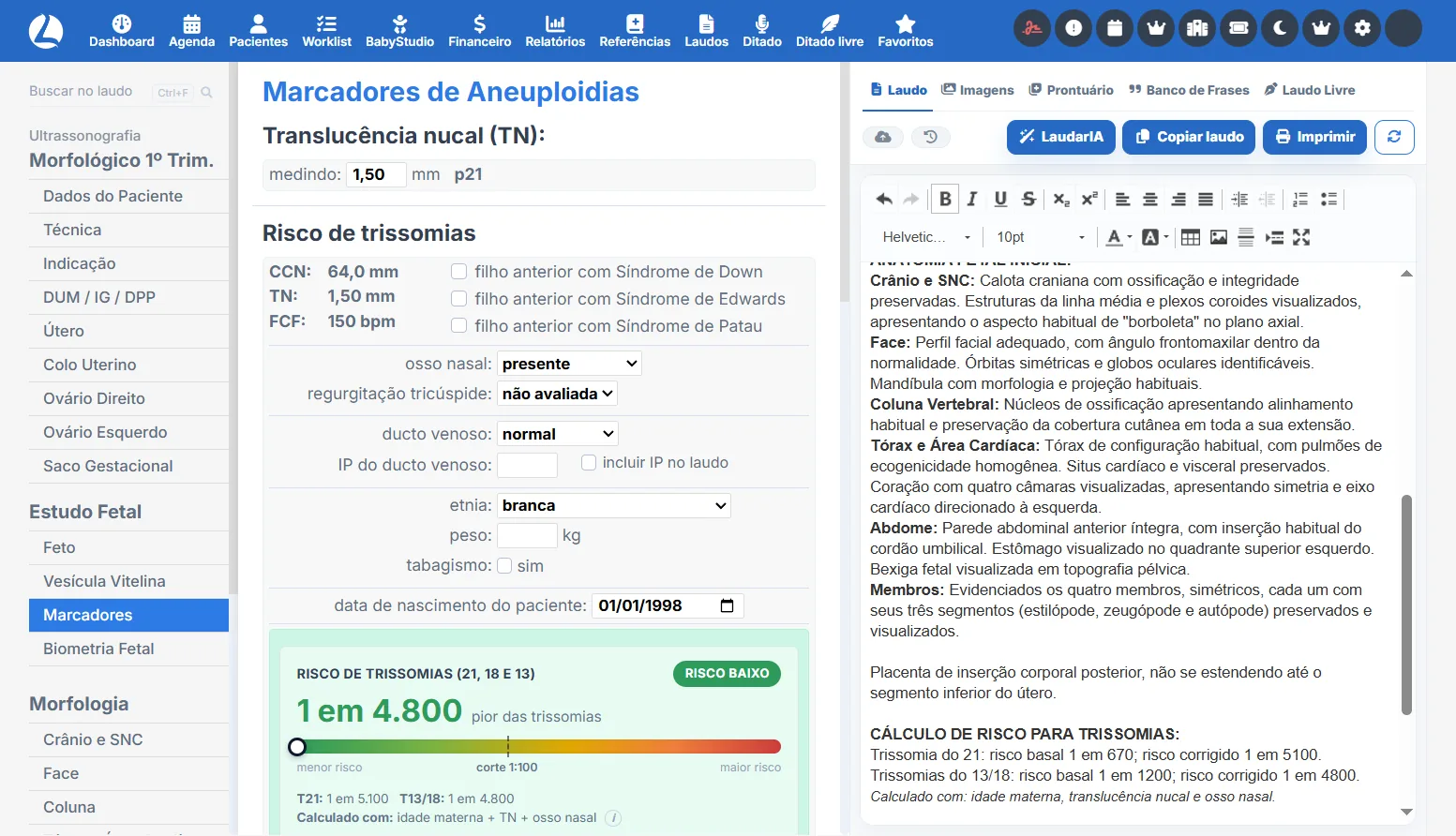
In Laudário, the calculation uses the measurements the physician has already filled in the report:
- Trisomies 21, 18 and 13: maternal age, CRL, nuchal translucency and, when assessed, nasal bone, ductus venosus and tricuspid regurgitation.
- Preeclampsia: maternal factors, mean arterial pressure and uterine artery pulsatility index, with biochemical markers when available.
Change a measurement and the risk changes with it. There is nothing to copy.
How the result appears
- On screen, a visual indicator shows which range the risk fell into.
- In the printed report, a table shows the baseline and adjusted risk for each trisomy, and the preeclampsia risk.
- The cutoffs are standardized: high, intermediate or low risk, with the same rule in all of the clinic's reports.
Twin pregnancies
Twin pregnancy is precisely where a separate calculation complicates things the most. Laudário calculates the risk per fetus, taking chorionicity into account, and also the preeclampsia risk of the twin pregnancy.
Why integrate
- No discrepancy. The number in the report is the number calculated.
- Less time. Measurements are typed once or arrive from the machine via DICOM SR.
- Management together. High preeclampsia risk appears in the report, and the aspirin recommendation goes to the recommendations.
Cautions that do not change
- The quality of the measurements is what defines the quality of the risk: scan plane, caliper position and uterine artery Doppler technique.
- The report should make clear that this is screening, not a diagnosis.
Also read about nuchal translucency and reporting the risk and about uterine artery Doppler.
How Laudário helps
In the first-trimester report of Laudário:
- Trisomy and preeclampsia risk calculated inside the report.
- Risk table printed in the report.
- Twin pregnancies with risk per fetus.
- Growth and Doppler charts in the same report.
Try it for 15 days free, no credit card.
The ultrasound reporting platform built by sonologists. We write about reports, classifications and standardization from the real routine of the practice. Who writes and how.
Educational content for healthcare professionals. It does not replace clinical judgment or the guidelines adopted by your service. Editorial policy.